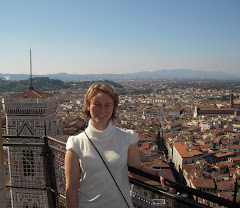
Classes have finally started, and I definitely have some mixed feelings about this. On the one hand, I’m very eager to be learning, you know, non-language-y material again; however much I love languages, I like to think about real world stuff beyond just basic grammar, and am looking forward to doing so again - while learning Italian simultaneously! On the other hand, I’m intimidated. No qualifiers necessary. I’m just plain intimidated. Mostly of my art history of Emilia Romagna (this provence) class, although I haven’t had 3 of the 6 yet, so we’ll have to see what happens with those later on.
Ok, I should probably actually tell you what classes I intend to take while here. (First, a point about the structure of the semester here: some courses continue for the whole term, some for only half and start either around now or around the beginning of November. I say “around” because while most first-half courses start this week, one of mine won’t start until next, as the group of us found out today by waiting for the prof for 20 minutes before someone came and told us the real starting date…) I will be continuing the Middlebury Literatura Ferrarese e Scrittura class that we’ve had for the last two weeks, and which will end at the beginning of November, although Middlebury will for some reason be counting it as a full course credit unlike the other half-term courses. I decided to not take a literature course at the university, unlike like what I am previously thought, and am instead thinking of taking the equivalent (Dante, Petrarch, Boccaccio, etc!) back at Middlebury at some point. I AM however probably going to do Human Geography (first half), Italian Linguistics and Dialects (first half), Medieval Art History (focus on Italy) (second half), Iconography and Iconology (second half), and Art History of Emilia Romagna (full term).
I’ve had the Ferrara literature course for the last two weeks, and have my midterm in it this Friday; it’s not a very challenging course so far, and although it’s sometimes boring I’ve generally been enjoying it. The professor is very friendly, and I’m glad to finally be reading real material in Italian, as well as grateful for how it gave me a way to get back into the language after Arabic school. The stories and poems, all about the character and history of this city, are rather depressing in and of themselves though. I already explained some of this, with how the city is characterized as being dead. Although I still stand by my earlier argument against that, the more I learn about specific events in the city’s history and think about the way people treat them in modern day, or as I see more about how people interact on a daily basis, I’m starting to understand the “apathetic and distant” characterization of Ferrara. But more on that at a later date.
I’ve had my Geography course twice now, and think I’ll stick with it. I introduced myself to the professor as an international student, like they recommended to us, and had the sometimes amusing result that today in class the professor repeatedly made comments and jokes about the US, or drew comparative examples between Europe and the US, and had a tangent about how he didn’t believe me that spoke English because “it is predicted” that American English will be destroyed in 20 years by online-chat spelling and Americans being lazy and speaking too quickly and not caring about saying things properly. A few of his comments made me want to protest, and a few were, as far as I knew, actually wrong. Despite the fact that he seemed to interact much more with the students than they say is normal for Italian professors to do, I still didn’t think it would be appropriate to outright contradict the professor in front of the whole class. And so just chuckled and listened.
His teaching style is radically different from that of Pete Nelson, the fantastic geography professor I had at Middlebury last spring. Pete’s course last spring was extremely well organized, logically layed out, a mix between lecture and discussion, had clearly relevant examples, and moved from the theoretical to the applied, which was in turn organized in terms of an increasing spatial/network-size scale. Makes sense for a course on Economic Geography, right? Things that have struck me about how this professor here teaches: how he introduces topics (or doesn’t), how he didn’t give much of a theoretical basis at the beginning and just jumped in pretty quickly, gave a pretty generalized overview of the course (I really have no idea what the layout, structure, or topics are actually going to be – except that they won’t include physical geography, which made me think “well, duh”), and the storytelling, tangential feeling of all the examples. He pretty quickly got into talking about demographics and population issues, so I guess that’s the first subject of the course.
For anyone who doesn’t know, the classroom etiquette and structure in Italy (and much of Europe) is very different from in the US: teacher stands up at the front, doesn’t even introduce themselves, doesn’t ask for students’ names, anything. And lectures. For two hours. There is no syllabus. There are no daily handouts. There is no daily homework. In fact, you don’t even sign up for the class – you sign up for the exam, at the end of the term, and then maybe show up for the ORAL exam in exam month (for me, January). I say maybe because some Italians will take a class one year and if they don’t feel prepared or can’t attend the exam period, they just do the exam the following year. I have no clue how they remember everything, but hey! That’s what they do. You’re expected to have read all the recommended books, and attended the lectures, and if you didn’t, then sucks for you, you get one shot at a grade. Oral comprehension and examination is VERY BIG here, meaning I had better learn to speak/understand Italian better, and quickly.
With this course, thankfully, I felt pretty comfortable understanding the majority of what he was saying, which was a great feeling. I couldn’t catch enough of the vocabulary to write all my notes actually in Italian, but could somehow understand them well enough to get the concepts and write them out in English. With a few random words in Arabic, Japanese, and French, as is the nature of my strangely mixed note-taking shorthand. I couldn’t understand everything, but it was easy enough to follow, the professor seems really friendly, and it will intriguing to see what “human geography” means from the Italian perspective. Already I could tell some differences in material, by the examples the prof gave (ie: afghani immigrants, not hispanics).
In general since my last post, I have been feeling increasingly comfortable in the language every day, which is nice. I’ve just accepted the fact that I’m not quite as good at speaking as are the others in the program, and the fact that occasionally I get some interference from my other languages. If that’s the consequence of me doing several at a time, then that’s what I have to deal with. For the most part, it hasn’t been that big of a problem recently. I’ve gotten used to the expectation that I won’t understand anywhere close to everything I encounter in Italian, but unlike in Arabic school, I do expect of myself that I can understand a lot. (I was in first year Arabic, and although we could comprehend and say quite a lot by the end of the program, I was never taken aback when I couldn’t get something – that was just the environment, a fun but constant challenge, designed to expose you to higher levels of language than your own.) My expectations perhaps set me up for a bit of a shock last night, though.
I don’t like to complain, but I think this next bit I just have to get out, so please forgive me for the grumpiness:
The other class I’ve attended so far kind of scared the hell out of me, I have to admit. It was the course on Art History of Emilia Romagna, and although I am used to having to put a lot of time and work in to the Middlebury HARC (history of art and architecture, in case I refer to that again) courses, I am also accustomed to being able to notice visual details and patterns, and to understand concepts easily and to having a strong foundation both for methodological theory and the vocabulary of a wide aray of art/architectural forms. That being said, I know the specialized vocabularly for 1) concepts, 2) theories, 3) artistic forms in ENGLISH. NOT ITALIAN. I kind of got wacked with this fact in class yesterday, after being so strongly encouraged by the geography class and by the various books I’m reading in Italian right now. And wacked hard.
In the two hours of lecture, I maybe (with some serious wishful thinking) got half-2/3 of the general concepts. And by that I mean general concepts that were mentioned over the first half-2/3 of the class period. Hence the probably wishful thinking about the first comment. I understood much of what he said for the first ten minutes, which was good, and it got progressively harder. The last major chunk of class I could catch individual phrases but had no real clue at all what he was talking about. I don’t remember anything from that part of the class, except for the fact that we’re going to have unofficial mini oral exams at the beginning of each month (good thing to have caught, eh?) The professor kept looking at me for the first big part of the class, and kept asking everyone (but often while looking at me) if we understood, and telling us to ask questions if we didn’t. The problem was that I had no idea what to even start with in order to ask about. I’m sure the concepts wouldn’t have been difficult – if I had a clue what they were. At one point, he was talking about woodcutting and a process like lithography as a method for distributing copies of famous images for educational purposes. 1) I missed why this was an important point, and 2) he had to explain for 10 minutes what “incisione” was, as I think I wasn’t the only one with an unknowing facial expression when he asked “so, you know what this is, right?” I felt silly once I figured it out. This is going to be an interesting way to learn vocabulary, I have to say. If I can understand anything that’s going on, that is.
Beyond the vocabulary, I think part of the problem was his accent – very unclear, with “r”s that sounded almost like the consonant version of a “y”, and generally very mumbly, made worse by the fact that the nearly empty room reverberated with his voice. Me being hungry, exhausted from the day, unprepared for my inability to comprehend anything, the way he asked me a few direct questions (which I couldn’t understand and had missed the context of), etc. just really made this a stressful experience. I also started getting really homesick in the middle of it and just wanted to leave, and almost burst out crying when Leah asked me afterwards if I were ok, on our way to yet another class, and actually did burst out crying when I got home later.
Not so happy Emmons. Being exhausted, homesick, lonely, and very intimidated does not make a good combination, even when low blood sugar is taken out of the equation. Luckily, Mary Katherine (a friend from Middlebury, from those of you who don’t know) messaged and then webcam-called me when I got home, and talking with her for a while made me feel a lot better, as did getting to talk with my brother Alex for a while after that. However, I did have to go to sleep with the quilted valentine from my mom and one of my shawls as a substitute for my comfort-blanket, which is of course at home for its protection...
So yeah, that wasn’t such a good ending to my first real day in a foreign university. I know it will get much easier, and that this will greatly improve my Italian, that everything will be ok and being here will be worth it in the end. But let’s just say that in the last few days I have gotten a huge new appreciation for Middlebury (English language, the campus, the clothes washers and dryers (so important!), familiar environment, friends there and family not terribly far away (so important!!!), well organized website and course information, an actual bookstore that has the books you need for class, not in a city, people to come home to at night, people to hug and hang out with more easily, a community, Xenia, only having to cook when I want to instead of all the time, oh so many resources and nice facilities, etc. etc. etc.) And that’s not to even mention the comforts of being at home-home with my family. Can you tell I got homesick/Midd-sick for the first real time here yesterday? I’m trying in general to be optimistic, because if I get too upset about the difficulties here, I expect it might be hard to pick myself up and enjoy being here after that, especially given what others have told me about troubles being lonely while abroad. Usually my attitude here has worked. Yesterday just rather made me crash, though. At least today’s class (geography) went well again. That’s positive… Let's see how this art history class goes again tomorrow (please be less stressful!)
If I ever am overly stressed out by Middlebury again, someone please just remind me that I could actually go full time to an Italian university, and that I should just stop and think about what I do have that’s good in my life (quite quite a lot). Here’s to being optimistic and perservering.
I don’t think I have mastered the philosophy of “boh!” yet. Need to work on that.
Next up: traveling adventures, including Venice! But first, to dinner…
Showing posts with label culture shock. Show all posts
Showing posts with label culture shock. Show all posts
Tuesday, September 30, 2008

Tuesday, September 23, 2008
"The City of Silence"
((Note: new pictures of Ferrara on flickr!)
Just over two weeks ago, I arrived in this almost-familiar-but-oh-so-different country named Italia, in a city called Ferrara. I have since learned that in literature and art this place has often been considered lifeless, apathetic, empty, provincial. Dead. But I don’t think I quite agree. On one hand: Ferrara’s streets, grocers, and piazzas are rarely that crowded. The few times I have eaten out, the vast majority of tables were empty; same with the benches in the park. Giovecca’s diesel cars can be noisy at night, and at quarter of and on the hour church bells toll – but the city is generally pretty quiet, pretty calm. Usually if I hear someone yelling, it’s a kid or teen at a distance from their friends, and as far as I can tell, there are no or few places resembling the famed dance clubs of Europe – meaning even the youth probably don’t stay out as late as they might in a larger city. Oh, and that’s not to mention the 3+ hour break most stores, restaurants and institutions take in the middle of the day. There are museums here, but I rarely see people going in and out, at least when I’m nearby. Ferrara is literally one of the oldest cities in Europe (in terms of demographics and ages) with one of the lowest growth rates, and you can see the evidence everywhere you go. It is a dignified but quiet city. As someone often overwhelmed by cities after a relatively short period of time, I am grateful that for the first time in which I live in a city for an extended period, I reside somewhere without the speed and noise and dirt of, say, New York or Boston. Florence even might have been a little too stimulating for me.
This place does often seem like it’s on the edge of sleep, and occasionally, like it’s still somewhat living in the past. I mean in terms of atmosphere, rather than technology. It’s hard to explain, especially without having lived here for very long. But it’s not lifeless, nor is it apathetic about its history and monuments, like some of the authors proclaim. Just about every adult with whom I’ve had a more than transactory conversation has insisted that I learn about the history of the city, showing such pride in the great amount of people and stories that have passed through here, the fact that we are a massive UNESCO World Heritage Site, the numerous palaces, the art within them (although much of it was removed to Florence and Rome), the rank of first “modern” urban-plan city, the retainment of Byzantine, Medieval and Renaissance structures all within a 15 minute walk or less from each other, etc. etc. etc. People seem proud to be from Ferrara (although that is something that seems to happen no matter where people are from). There was a night tour last week of the oldest part of the city, about which few know, although a number live there, and, I do not exaggerate, hundreds of people showed up. For a tour led by one man. (yes, one…!!! And it… kind of worked.) Beforehand, they seemed so excited for the chance to learn more about their city’s history. Maybe the life of this place is sustained by a love of its past glories, and economically by the bit of tourism inspired by the same, as well as some small commerce and the great surrounding agricultural lands. Some might say that this makes this place dead. But underneath the tranquility and quiet everpresence of history, there is an energy here that I can’t quite place or figure out. It’s as though Ferrara acts like a small town but wants to be a city. It’s a living energy humming underneath, of course, but a puzzling, subtle one.
On a slightly different note, and a more every day basis, there is a word that describes what, at least for us foreigners, life here is often like. This probably applies for all or much of Italy, but not just for foreigners.
That word is “Boh”.
It can be used to mean any or a mix of: I don’t know, well, whatever, who knows? , there’s nothing to be done so why worry?, it doesn’t matter, who care’s, even if there’s something wrong I can’t do anything but it will work out somehow, - and various other ambiguous types of comments in English, usually when presented with an unanswerable question, unresolved issue, or a problem over which one has no control. (except for the fact that in the USA, you might be pestered until you thought of an appropriate answer, here, they don’t bother pushing. The boh is the long and short of it, pointblank period). As Leah has put it well, much of life here makes one constantly feel like asking “did I get left off the mailing list?” and when things aren’t well prescripted or don’t turn out how you planned, Boh! is the only good response that serves to write off the problem and move on smoothly. The out-of-the-loop feeling is due not only to the fact that we are very much not Italian and don’t know all the expected customs and specific words, but also to the massive amount of 1) ambiguity and disorganization, and 2) bureaucracy, and the resulting paperwork, meetings and defintions. The necessary reponse to challenge in order to make it through Italy is “boh”. Incredibly multi-purpose word, for being such a simple sound.
I’m afraid, however, that it is late and the associated stories will have to wait until tomorrow. Good night, and be well.
Just over two weeks ago, I arrived in this almost-familiar-but-oh-so-different country named Italia, in a city called Ferrara. I have since learned that in literature and art this place has often been considered lifeless, apathetic, empty, provincial. Dead. But I don’t think I quite agree. On one hand: Ferrara’s streets, grocers, and piazzas are rarely that crowded. The few times I have eaten out, the vast majority of tables were empty; same with the benches in the park. Giovecca’s diesel cars can be noisy at night, and at quarter of and on the hour church bells toll – but the city is generally pretty quiet, pretty calm. Usually if I hear someone yelling, it’s a kid or teen at a distance from their friends, and as far as I can tell, there are no or few places resembling the famed dance clubs of Europe – meaning even the youth probably don’t stay out as late as they might in a larger city. Oh, and that’s not to mention the 3+ hour break most stores, restaurants and institutions take in the middle of the day. There are museums here, but I rarely see people going in and out, at least when I’m nearby. Ferrara is literally one of the oldest cities in Europe (in terms of demographics and ages) with one of the lowest growth rates, and you can see the evidence everywhere you go. It is a dignified but quiet city. As someone often overwhelmed by cities after a relatively short period of time, I am grateful that for the first time in which I live in a city for an extended period, I reside somewhere without the speed and noise and dirt of, say, New York or Boston. Florence even might have been a little too stimulating for me.
This place does often seem like it’s on the edge of sleep, and occasionally, like it’s still somewhat living in the past. I mean in terms of atmosphere, rather than technology. It’s hard to explain, especially without having lived here for very long. But it’s not lifeless, nor is it apathetic about its history and monuments, like some of the authors proclaim. Just about every adult with whom I’ve had a more than transactory conversation has insisted that I learn about the history of the city, showing such pride in the great amount of people and stories that have passed through here, the fact that we are a massive UNESCO World Heritage Site, the numerous palaces, the art within them (although much of it was removed to Florence and Rome), the rank of first “modern” urban-plan city, the retainment of Byzantine, Medieval and Renaissance structures all within a 15 minute walk or less from each other, etc. etc. etc. People seem proud to be from Ferrara (although that is something that seems to happen no matter where people are from). There was a night tour last week of the oldest part of the city, about which few know, although a number live there, and, I do not exaggerate, hundreds of people showed up. For a tour led by one man. (yes, one…!!! And it… kind of worked.) Beforehand, they seemed so excited for the chance to learn more about their city’s history. Maybe the life of this place is sustained by a love of its past glories, and economically by the bit of tourism inspired by the same, as well as some small commerce and the great surrounding agricultural lands. Some might say that this makes this place dead. But underneath the tranquility and quiet everpresence of history, there is an energy here that I can’t quite place or figure out. It’s as though Ferrara acts like a small town but wants to be a city. It’s a living energy humming underneath, of course, but a puzzling, subtle one.
On a slightly different note, and a more every day basis, there is a word that describes what, at least for us foreigners, life here is often like. This probably applies for all or much of Italy, but not just for foreigners.
That word is “Boh”.
It can be used to mean any or a mix of: I don’t know, well, whatever, who knows? , there’s nothing to be done so why worry?, it doesn’t matter, who care’s, even if there’s something wrong I can’t do anything but it will work out somehow, - and various other ambiguous types of comments in English, usually when presented with an unanswerable question, unresolved issue, or a problem over which one has no control. (except for the fact that in the USA, you might be pestered until you thought of an appropriate answer, here, they don’t bother pushing. The boh is the long and short of it, pointblank period). As Leah has put it well, much of life here makes one constantly feel like asking “did I get left off the mailing list?” and when things aren’t well prescripted or don’t turn out how you planned, Boh! is the only good response that serves to write off the problem and move on smoothly. The out-of-the-loop feeling is due not only to the fact that we are very much not Italian and don’t know all the expected customs and specific words, but also to the massive amount of 1) ambiguity and disorganization, and 2) bureaucracy, and the resulting paperwork, meetings and defintions. The necessary reponse to challenge in order to make it through Italy is “boh”. Incredibly multi-purpose word, for being such a simple sound.
I’m afraid, however, that it is late and the associated stories will have to wait until tomorrow. Good night, and be well.
Friday, September 12, 2008
On Families and Foreigners
Hmm, I just realized that blogspot’s clock thinks I’m still on the East coast, although it automatically changed my language to Italian. Huh. Again, please look at the link to my photo-gallery on flickr and the request for recipes at the beginning of the post called “Arrival in Italy.” Food suggestions would be fantastic. Grazie.
--------
Here, they call me Elisabet(h). Or Elisabetta, depending on how Italian their English sounds. It’s really very strange for me, since I have never been called by my first full name for very long at all in my entire life. I’m sure you are asking why, therefore, has my name changed here? It seems to be because Gardenia noticed that the name associated with my email address, from when we were arranging for me to rent her room, began with Elisabeth, regardless of how I signed my emails, or the comment I made about how I’m usually not called that. So here I am, having been told about to several people in Gardenia’s family who looked confused when I introduced myself as Emmons, until I said “o Elisabetta” in the fatigue of my first day, just to avoid too much hassle. Despite the fact that I have been called Elisabetta by several of the Italian professors at Midd, and I picked it for my name on this blog, it still feels strange. It is yet one more thing that makes being here feel somewhat surreal, like this is a life completely apart from that in the United States. This sense of walking in a dreamland of beautiful words and Renaissance houses became confused even further today, by the thankfully safe arrival of Leah (who, for those of you who don’t know, is one of my friends from Middlebury who is also studying here for the fall), bringing a piece of home (well, my Middlebury home) in the form of a friend. We talked for hours in Italian, walking around and eventually getting dinner; it was reassuring to see someone familiar, a good friend, but it also reminded me of how much we are simply visitors to this place for 5 months, as well as it mixing up these worlds. However, I’m definitely glad she’s here.
I’m also glad for the ability to communicate so quickly with you all across the ocean through the internet. Receiving some responses to my pictures and posts from yesterday, and general messages this week was very reassuring, and made me feel loved. Thanks, guys.
I have already been experiencing what the Italian definition of family means: lots of interaction. Beyond Gardenia, Giorgio (whom I still have hardly seen), and Andrea, I have met Flavia, the daughter of Gardenia and Giorgio, and one of her daughters, Aurora. Aurora is 11, while her other sister, gone for a few days with some friends before the start of her last (5th, I think) year of highschool, is Angelica and is almost 19. On Wednesday, I was roused from my leasurely lunch of cold pizza to go shopping and to begin the search for a cellphone for me. This of course had to include all the above mentioned family members, for some unknown reason, meaning my introduction to Flavia and Aurora. Flavia is an artist, although because when I asked her about it she replied along the lines of “Well, sort of…” I’m not sure if she does a lot of art but has another job, or is just humble about it. Aurora is very sweet, and helped me do some shopping, giving me recommendations on cheese and prosciutto and translating fruit juices for me. I think I know now a little of how the Japanese teenagers who came to stay with us when I was younger felt about hanging out with a kid who wasn’t even a teenager yet but was interested in their culture. I like talking with her, but it’s an odd feeling to be at such a lower language level than someone barely more than half my age. I haven’t spent much time with her, and haven’t met her sister yet, but hopefully we’ll get along alright. They’ve showed up at the house several times in the last few days, so I assume I’ll have plenty of time to get to know them all better.
None of the stores we looked in had a cellphone at a decent price, so eventually we all went our separate ways. Flavia first offered to bring me to the ocean sometime soon if it works for her schedule, which would be awesome. If it doesn’t, I’ll just find some other way. Boh, as they say in italiano. We were at her house for something yesterday, just a few blocks away from here, after which Flavia took me home on her scooter! Pretty fun, but I expect it would have been scarier if we were actually going on the main road for more than a block, given the speed some of those go around town. At some point Wednesday afternoon, I ended up going exploring and taking most of the pictures that I put up on flickr yesterday. It was fun to do so, and helped me to feel a little more aware of where it is I have landed for 5 months. After so much sitting on the way here, and not knowing much about this place, I’ve been kind of restive to explore. As I mentioned before, that first afternoon I wandered down to the city wall and back up around the castle for a few hours, just kind of being amazed by the buildings and sounds and smells and the fact that I’m actually in Italy. I took another long walk yesterday, and then today before meeting up with Leah, and then with her, slowly expanding the area through which I’ve been and gradually getting past the fact of being here towards noticing more details about my surroundings: the different apparent shopping districts near here (today we found one with a bunch of fruit/vegetable vendors!), the way the bikes mostly look really old fashioned, even the new ones, the way even the Italians’ casual clothes like t-shirts have a higher standard of fashionable-ness than we do in the US, the languages different kinds of stores pick to have for their multi-lingual options, the way kids pile onto bike handles and the bike-riders shoulders (with no helmets in sight whatsoever) 2 or 3 at a time, the way people ignore each other absolutely and completely as they walk through the streets like true city-people, but greet many of the shopkeepers with such affection as to make you think you’re in a small town where everyone knows everyone and everyone knows what everyone is doing. The sidewalks are often either surprisingly wide or ridiculously skinny, and some roads cobbled with serious rocks (not bricks, not neat stones - and a great way to break an ankle), and some new and neatly paved. I’ve seen a very small handfull of rollerbladers (makes me miss mine) and even a girl riding a bike while wearing blades, beyond the scores of kids and businessmen alike on bikes. A few more trees do exist here than I had previously noticed, of course, but on the other side of the castle plaza, where I found a large park near Leah’s hostel and some fountains in plazas (piazze) scattered among the winding streets.
Being surrounded by, well, Italians, is a little odd sometimes. In Japan, I stood out not so much like a sore thumb, but rather a broken leg in a cast. But being surrounded by Japanese people, walking streets with buildings that looked absolutely nothing like those in America, and not having even a clue as to how to pronounce most of the signs, I very quickly got used to the idea of feeling a foreigner. Here it’s a half-way zone, for a number of reasons (at least so far, with my mere 3.5 days of experience). Yes, the architecture looks neither like Mountain Lakes nor Middlebury, but the style’s not as far out of my experience as was Japan. Due to the large amount of Italians/Italian-Americans in New Jersey and New York – heck, in the US in general – plus those in my family, most of the people around here look like they could very well be American at my first impulse. The main difference (besides the fact that they aren’t American, and speak Italian) is the lack of other kinds of people. I have now seen a grand total of 6 Asians – one touristy family speaking Chinese, and some women in the restaurant we went to tonight speaking Japanese, which quite confused me for a bit - plus maybe about 10 blacks, and 3 noticeable Arabs. And that’s it. Bizarro-land compared to the human stew of the US – especially in comparison with NYC, where one can find easily any color skin or facial or body shape imaginable, and even some unimaginable. I know it’s to be expected that there be many Italian-looking people here, but it still is going to take some getting used to.
Some of the Italians, like little Aurora, are blond like me, and don’t look overly Italian or German or anything clearly ethnic in any direction beyond Caucasian. And some of them do speak English – with an American accent, mind you, which makes the first group of non-Americans I have ever met who learn American and not British. And unlike in Japan, I don’t get weird looks for appearing a foreigner right off the bat. Which is nice, but leads to momentary confused looks every time I open my mouth. Speaking of which, my Italian is already improving, thankfully, but sentences with mixes of subjunctive and conditional and hypotheticals regularly make me stumble, much as always. My agreement (gender and number) skills often fail, too, which serves to make me very self-conscious. But it’s getting better, and as long as I can communicate and deal with classes without freaking out, once they finally start in a week+, I won’t worry too much. Until the Oral Exams begin, that is. But that’s in another 4 months, so I’m mostly not thinking about that yet.
Another interesting thing about languages here: there’s ARABIC.
Not much in the city center at all, but apparently most of the signs in the hospital are done in Italian and Arabic, and I’ve already seen several official signs and advertisements, mostly outside the city center, with an Arabic translation. Several of them with ancient Egyptian style drawings, which were pretty funny. It made me really happy to be able to actually figure out the meaning of the Arabic ads I saw, before reading the Italian equivalents. In the more touristy parts of the city center, French and German, Spanish and a bit of Portugeuse, and the occasional English, abound in expected European style. But the Arabic is apparently used for the more practical and official signs due to a large immigrant population here, living somewhere out of sight, I suppose in the poorer outskirts of the city – I am told it is the largest language group here after native Italian-speakers. I was aware that there are a multitude of Arab and African immigrants in Southern Italy, but was rather surprised to hear about how many are here. When I asked Gardenia about if there was any prejudice, her first response was no, but then admitted that many people are very angry about how many jobs they take and about the influx of the Muslim culture. It sounds like they’re kind of like the Mexican/ S. American poor in the US. I’m quite curious to find out more, but haven’t had occasion to ask or see anything else yet concerning the immigrants.
So anyway. As I was saying, there’s a weird half-way feeling of being in a very different culture, whose differences I can barely see yet, but also being in one superficially very close to my own. This came up when I finally acquired a cellphone – store just like our electronic megastores, but the beaurocratic mess that I had to go through to buy a SIM card included needing proper documentation for some unknown reason – which of course I didn’t have with me. The cell phone finally works, but it took two whole days for them to process my purchase (mostly because of the documentation problems) and turn it on. I will also need to acquire a “codice fiscale” in order to make my rent contract, an official government number given to all citizens (so I’m not quite sure how I go about getting one) upon birth that goes back to all the problems with terrorism that Italy has had in the last few decades. These things and a myriad of little other confusing customs and expectations constantly remind me of my foreign-ness everytime I start to figure one thing out, or feel comfortable doing something. And that’s not even to mention the way I forget that we’re all speaking in Italian and how English already sounds out of place in public, except for the way the language just runs into wavy little dark red (and other colors, too, occasionally) fuzzy streamers in the air when I don’t pay attention or can’t understand what people say.
In short, I’m already having something of a culture shock. I’m quite eager for the months here, but simultaneously nervous for the homesickness that will eventually hit, and for classes in the more immediate timeframe. I’m still waiting for the day I’ll wake up and feel like I’m awake, preferably without the noisy cars and ambulances racing by outside. Or the day when I actually get a good night’s sleep, and can wake up without being surprised to be in Italy.
Ma sono in Italia, e intendo di essere, davvero e in fondo, qui.
--------
Here, they call me Elisabet(h). Or Elisabetta, depending on how Italian their English sounds. It’s really very strange for me, since I have never been called by my first full name for very long at all in my entire life. I’m sure you are asking why, therefore, has my name changed here? It seems to be because Gardenia noticed that the name associated with my email address, from when we were arranging for me to rent her room, began with Elisabeth, regardless of how I signed my emails, or the comment I made about how I’m usually not called that. So here I am, having been told about to several people in Gardenia’s family who looked confused when I introduced myself as Emmons, until I said “o Elisabetta” in the fatigue of my first day, just to avoid too much hassle. Despite the fact that I have been called Elisabetta by several of the Italian professors at Midd, and I picked it for my name on this blog, it still feels strange. It is yet one more thing that makes being here feel somewhat surreal, like this is a life completely apart from that in the United States. This sense of walking in a dreamland of beautiful words and Renaissance houses became confused even further today, by the thankfully safe arrival of Leah (who, for those of you who don’t know, is one of my friends from Middlebury who is also studying here for the fall), bringing a piece of home (well, my Middlebury home) in the form of a friend. We talked for hours in Italian, walking around and eventually getting dinner; it was reassuring to see someone familiar, a good friend, but it also reminded me of how much we are simply visitors to this place for 5 months, as well as it mixing up these worlds. However, I’m definitely glad she’s here.
I’m also glad for the ability to communicate so quickly with you all across the ocean through the internet. Receiving some responses to my pictures and posts from yesterday, and general messages this week was very reassuring, and made me feel loved. Thanks, guys.
I have already been experiencing what the Italian definition of family means: lots of interaction. Beyond Gardenia, Giorgio (whom I still have hardly seen), and Andrea, I have met Flavia, the daughter of Gardenia and Giorgio, and one of her daughters, Aurora. Aurora is 11, while her other sister, gone for a few days with some friends before the start of her last (5th, I think) year of highschool, is Angelica and is almost 19. On Wednesday, I was roused from my leasurely lunch of cold pizza to go shopping and to begin the search for a cellphone for me. This of course had to include all the above mentioned family members, for some unknown reason, meaning my introduction to Flavia and Aurora. Flavia is an artist, although because when I asked her about it she replied along the lines of “Well, sort of…” I’m not sure if she does a lot of art but has another job, or is just humble about it. Aurora is very sweet, and helped me do some shopping, giving me recommendations on cheese and prosciutto and translating fruit juices for me. I think I know now a little of how the Japanese teenagers who came to stay with us when I was younger felt about hanging out with a kid who wasn’t even a teenager yet but was interested in their culture. I like talking with her, but it’s an odd feeling to be at such a lower language level than someone barely more than half my age. I haven’t spent much time with her, and haven’t met her sister yet, but hopefully we’ll get along alright. They’ve showed up at the house several times in the last few days, so I assume I’ll have plenty of time to get to know them all better.
None of the stores we looked in had a cellphone at a decent price, so eventually we all went our separate ways. Flavia first offered to bring me to the ocean sometime soon if it works for her schedule, which would be awesome. If it doesn’t, I’ll just find some other way. Boh, as they say in italiano. We were at her house for something yesterday, just a few blocks away from here, after which Flavia took me home on her scooter! Pretty fun, but I expect it would have been scarier if we were actually going on the main road for more than a block, given the speed some of those go around town. At some point Wednesday afternoon, I ended up going exploring and taking most of the pictures that I put up on flickr yesterday. It was fun to do so, and helped me to feel a little more aware of where it is I have landed for 5 months. After so much sitting on the way here, and not knowing much about this place, I’ve been kind of restive to explore. As I mentioned before, that first afternoon I wandered down to the city wall and back up around the castle for a few hours, just kind of being amazed by the buildings and sounds and smells and the fact that I’m actually in Italy. I took another long walk yesterday, and then today before meeting up with Leah, and then with her, slowly expanding the area through which I’ve been and gradually getting past the fact of being here towards noticing more details about my surroundings: the different apparent shopping districts near here (today we found one with a bunch of fruit/vegetable vendors!), the way the bikes mostly look really old fashioned, even the new ones, the way even the Italians’ casual clothes like t-shirts have a higher standard of fashionable-ness than we do in the US, the languages different kinds of stores pick to have for their multi-lingual options, the way kids pile onto bike handles and the bike-riders shoulders (with no helmets in sight whatsoever) 2 or 3 at a time, the way people ignore each other absolutely and completely as they walk through the streets like true city-people, but greet many of the shopkeepers with such affection as to make you think you’re in a small town where everyone knows everyone and everyone knows what everyone is doing. The sidewalks are often either surprisingly wide or ridiculously skinny, and some roads cobbled with serious rocks (not bricks, not neat stones - and a great way to break an ankle), and some new and neatly paved. I’ve seen a very small handfull of rollerbladers (makes me miss mine) and even a girl riding a bike while wearing blades, beyond the scores of kids and businessmen alike on bikes. A few more trees do exist here than I had previously noticed, of course, but on the other side of the castle plaza, where I found a large park near Leah’s hostel and some fountains in plazas (piazze) scattered among the winding streets.
Being surrounded by, well, Italians, is a little odd sometimes. In Japan, I stood out not so much like a sore thumb, but rather a broken leg in a cast. But being surrounded by Japanese people, walking streets with buildings that looked absolutely nothing like those in America, and not having even a clue as to how to pronounce most of the signs, I very quickly got used to the idea of feeling a foreigner. Here it’s a half-way zone, for a number of reasons (at least so far, with my mere 3.5 days of experience). Yes, the architecture looks neither like Mountain Lakes nor Middlebury, but the style’s not as far out of my experience as was Japan. Due to the large amount of Italians/Italian-Americans in New Jersey and New York – heck, in the US in general – plus those in my family, most of the people around here look like they could very well be American at my first impulse. The main difference (besides the fact that they aren’t American, and speak Italian) is the lack of other kinds of people. I have now seen a grand total of 6 Asians – one touristy family speaking Chinese, and some women in the restaurant we went to tonight speaking Japanese, which quite confused me for a bit - plus maybe about 10 blacks, and 3 noticeable Arabs. And that’s it. Bizarro-land compared to the human stew of the US – especially in comparison with NYC, where one can find easily any color skin or facial or body shape imaginable, and even some unimaginable. I know it’s to be expected that there be many Italian-looking people here, but it still is going to take some getting used to.
Some of the Italians, like little Aurora, are blond like me, and don’t look overly Italian or German or anything clearly ethnic in any direction beyond Caucasian. And some of them do speak English – with an American accent, mind you, which makes the first group of non-Americans I have ever met who learn American and not British. And unlike in Japan, I don’t get weird looks for appearing a foreigner right off the bat. Which is nice, but leads to momentary confused looks every time I open my mouth. Speaking of which, my Italian is already improving, thankfully, but sentences with mixes of subjunctive and conditional and hypotheticals regularly make me stumble, much as always. My agreement (gender and number) skills often fail, too, which serves to make me very self-conscious. But it’s getting better, and as long as I can communicate and deal with classes without freaking out, once they finally start in a week+, I won’t worry too much. Until the Oral Exams begin, that is. But that’s in another 4 months, so I’m mostly not thinking about that yet.
Another interesting thing about languages here: there’s ARABIC.
Not much in the city center at all, but apparently most of the signs in the hospital are done in Italian and Arabic, and I’ve already seen several official signs and advertisements, mostly outside the city center, with an Arabic translation. Several of them with ancient Egyptian style drawings, which were pretty funny. It made me really happy to be able to actually figure out the meaning of the Arabic ads I saw, before reading the Italian equivalents. In the more touristy parts of the city center, French and German, Spanish and a bit of Portugeuse, and the occasional English, abound in expected European style. But the Arabic is apparently used for the more practical and official signs due to a large immigrant population here, living somewhere out of sight, I suppose in the poorer outskirts of the city – I am told it is the largest language group here after native Italian-speakers. I was aware that there are a multitude of Arab and African immigrants in Southern Italy, but was rather surprised to hear about how many are here. When I asked Gardenia about if there was any prejudice, her first response was no, but then admitted that many people are very angry about how many jobs they take and about the influx of the Muslim culture. It sounds like they’re kind of like the Mexican/ S. American poor in the US. I’m quite curious to find out more, but haven’t had occasion to ask or see anything else yet concerning the immigrants.
So anyway. As I was saying, there’s a weird half-way feeling of being in a very different culture, whose differences I can barely see yet, but also being in one superficially very close to my own. This came up when I finally acquired a cellphone – store just like our electronic megastores, but the beaurocratic mess that I had to go through to buy a SIM card included needing proper documentation for some unknown reason – which of course I didn’t have with me. The cell phone finally works, but it took two whole days for them to process my purchase (mostly because of the documentation problems) and turn it on. I will also need to acquire a “codice fiscale” in order to make my rent contract, an official government number given to all citizens (so I’m not quite sure how I go about getting one) upon birth that goes back to all the problems with terrorism that Italy has had in the last few decades. These things and a myriad of little other confusing customs and expectations constantly remind me of my foreign-ness everytime I start to figure one thing out, or feel comfortable doing something. And that’s not even to mention the way I forget that we’re all speaking in Italian and how English already sounds out of place in public, except for the way the language just runs into wavy little dark red (and other colors, too, occasionally) fuzzy streamers in the air when I don’t pay attention or can’t understand what people say.
In short, I’m already having something of a culture shock. I’m quite eager for the months here, but simultaneously nervous for the homesickness that will eventually hit, and for classes in the more immediate timeframe. I’m still waiting for the day I’ll wake up and feel like I’m awake, preferably without the noisy cars and ambulances racing by outside. Or the day when I actually get a good night’s sleep, and can wake up without being surprised to be in Italy.
Ma sono in Italia, e intendo di essere, davvero e in fondo, qui.
Subscribe to:
Posts (Atom)